

When writing or speaking about more than one monkey, the plural form of the word is monkeys, not monkies. This is a common challenge in English grammar, especially when it comes to words that end in -y. According to pluralization rules, when a noun ends with -y, the letter y is typically replaced with -ies to form the plural. In this case, the word monkey follows this rule, making the correct plural form monkeys. This is a simple application of basic morphology in English, where the structure of the word changes to indicate more than one.
However, like many other languages, English has exceptions to its rules of pluralization. While monkeys follows the common pattern, some nouns that end in -y do not follow this rule. For example, baby becomes babies and city becomes cities, while words like boy or toy simply add an -s for the plural form. The difficulty in these cases lies in remembering the rules of pluralization and recognizing when an exception applies. Despite these challenges, understanding the basic rules for plural nouns and their word forms is crucial for correct spelling and syntax in writing.
The plural of “monkey” is “monkeys.”
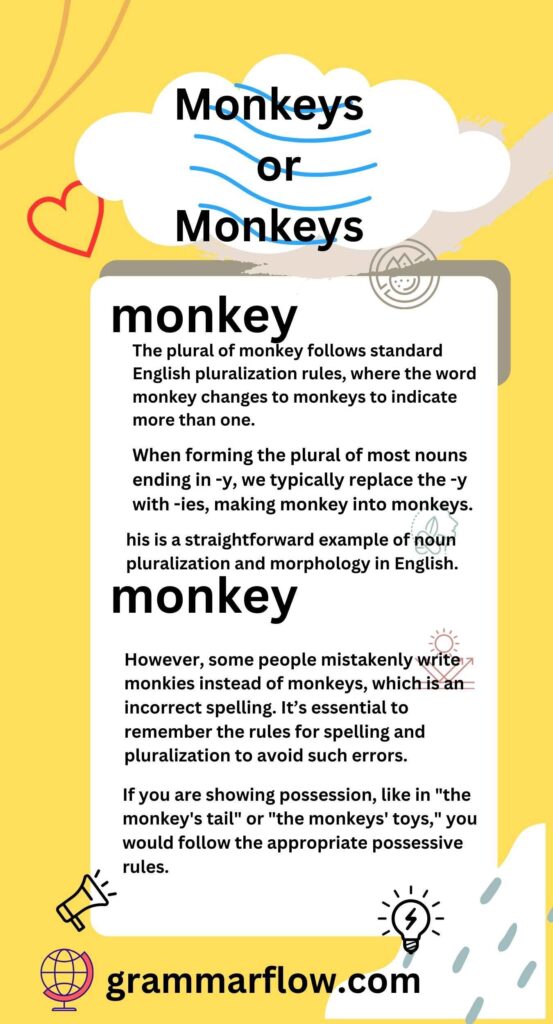
- The plural of monkey follows standard English pluralization rules, where the word monkey changes to monkeys to indicate more than one. When forming the plural of most nouns ending in -y, we typically replace the -y with -ies, making monkey into monkeys. This is a straightforward example of noun pluralization and morphology in English. For example, in a zoo, you would see many monkeys playing with toys in their cages, showing multiple monkeys rather than a single monkey with a long tail.
- However, some people mistakenly write monkies instead of monkeys, which is an incorrect spelling. It’s essential to remember the rules for spelling and pluralization to avoid such errors. If you are showing possession, like in “the monkey’s tail” or “the monkeys’ toys,” you would follow the appropriate possessive rules. Monkeys in possession can be written as monkey’s for singular possessive and monkeys’ for the plural possessive, indicating ownership. Using incorrect plural forms can break down the syntax and lead to confusion, so always be sure to apply the standard rules of pluralization.
You might enjoy reading: Performed vs Preformed: The Shocking Difference You Must Know!
Why “monkeys” and not “monkies”?
The reason monkeys is the correct plural form and not monkies lies in the rules of pluralization in English. When a noun ends with the letter y, the pluralization rule is influenced by the letter before the y. If the letter before y is a consonant (like k in monkey), we change the y to ies. This is a standard rule for pluralizing nouns ending in consonant + y, such as boy to boys or city to cities. On the other hand, if the vowel (like a, e, i, o, u) comes before the y, we just add s to form the plural (for example, day to days or key to keys).
In the case of monkey, since the letter k is a consonant before the y, the correct plural is monkeys, not monkies. Incorrect plural forms like monkies arise from misunderstanding the rules of morphology and syntax in English. It’s essential to learn these pluralization rules to avoid confusion and ensure correct spelling in writing. Remember, changing y to ies is a crucial part of pluralizing words that end in consonant + y in English grammar.
What is a monkey? Where did the word monkey come from?
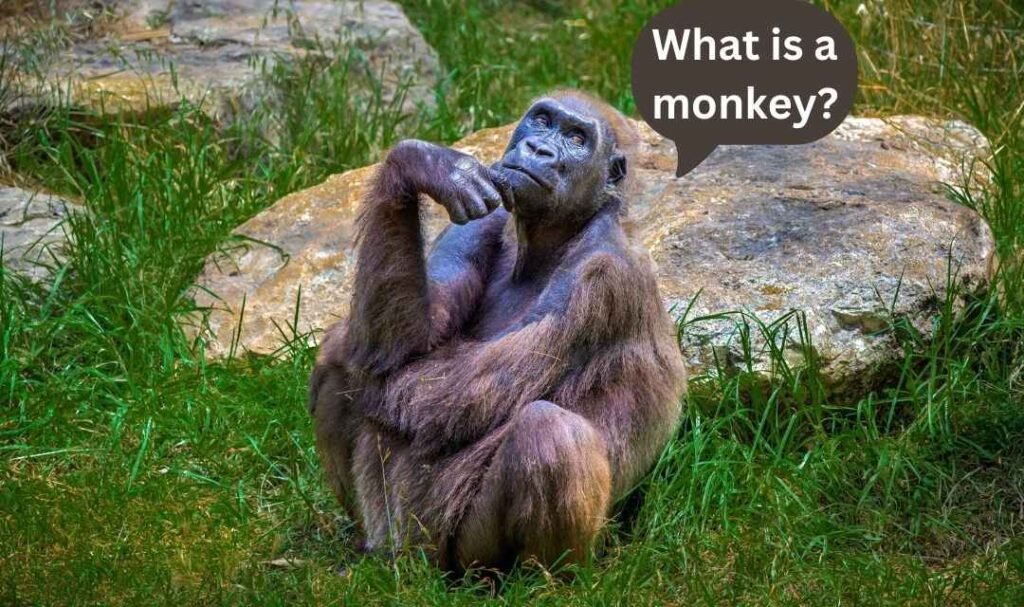
A monkey is a type of animal that belongs to the primate family, a group of mammals that includes species like the chimpanzee and chimp. Monkeys are known for their agility, social behavior, and cleverness. The word monkey itself has an interesting origin. It comes from the German word Moneke, a name used in the legend of Reynard the Fox, published in 1580. The word evolved through linguistic history, and some suggest it might have been influenced by folk tales and mythology, where animals often had symbolic meanings. In terms of animal classification, monkeys are part of the larger primate group, which includes both apes and monkeys, and they have a long historical reference in zoology and folklore. The word formation reflects the linguistic evolution of the term as it became more widely used in animal kingdom terminology.
Is it monkeys or monkies? Which is correct?
The correct plural form of monkey is monkeys, not monkies. This follows traditional grammar rules for pluralizing nouns that end in -y. When a singular noun ends in -y and is preceded by a consonant, the y changes to -ies to make the plural. So, monkey becomes monkeys. This is a standard grammar rule in English grammar that avoids confusion. While there are exceptions to the rule, like when a vowel precedes the y (as in boy to boys), monkeys follows the traditional form and word pluralization rules correctly.
Why “monkeys” ends in a -y and “s” letter
When forming the plural of most English nouns, we simply add an s to the end. However, in some cases, the pluralization involves a slight change, particularly when a word ends in y. For example, the word monkey transforms into monkeys when pluralized. This change follows the regular pluralization rule for words that end in a consonant followed by y. In this case, the y changes to ies, turning the singular monkey into the plural monkeys.
This is a common rule in English grammar, where a noun ending in a consonant and y undergoes a letter change during conversion to the plural form. However, there are exceptions in English, such as words like party becoming parties, and chimney becoming chimneys. The exception occurs when the y follows a vowel, where no letter change happens, and we simply add s. These linguistic patterns and morphology rules shape how we understand plural word forms in English, ensuring consistent and correct usage.
Sentence examples with monkeys

- Here are some sentence examples that show how monkeys are used in different contexts:
- The monkeys at the local zoo are always playful and active during the day.
- In the Amazon rainforest, many monkeys are endangered and face an extinction risk due to habitat destruction.
- At night, you can hear the sounds of monkeys in the trees, playing and swinging in their natural environment.
- The zoo animals, including monkeys, are part of the conservation program to protect endangered species from global extinction.
- Wildlife conservation efforts in the Amazon are crucial to ensuring the survival of species like the monkey, whose habitat is at risk due to biodiversity loss.
- A band of monkeys was spotted near the river, showing the importance of protecting their natural habitat for species protection.
- These sentences highlight how monkeys are not only fascinating to observe but also need urgent action to ensure their survival and protect the environment from ecological crises.
You might enjoy reading: Which of the Following: Definition+Usage+Grammar 2025
Is “monkies” ever used?
The word “monkies” is a common grammar mistake that many people make, but it is grammatically incorrect. The proper plural form of monkey is monkeys, not monkies. This error usually happens because the base word, monkey, ends in ey, leading some to mistakenly believe that the plural suffix should be ies, as with words like party becoming parties. However, this is not the case with monkey. In English, monkey follows the standard pluralization rule, where we simply add s to form the plural monkeys.
Using “monkies” is an example of incorrect spelling and incorrect plural formation. This mistake goes against language conventions and grammar rules, which dictate that the word monkey becomes monkeys in the plural. The confusion may stem from the fact that English has various rules for pluralizing nouns, but monkey follows its own linguistic pattern. Thus, while monkies may appear in casual speech or writing, it is not the correct usage according to English grammar.
Why Is There Confusion over the Plural of Monkey?
The confusion about the plural of monkey often arises from the noun ending in y. Many people mistakenly believe that because the word monkey ends with y, the plural form should follow the vowel + y rule. This would lead them to think the plural is monkies, following the pattern seen with words like party becoming parties. However, this is an erroneous belief. The standard rule for words ending in a consonant + y (like monkey) is to replace the y with ies, resulting in monkeys.
This misunderstanding stems from the general pluralization rules in English grammar, where we add s to most nouns to form the plural. For words ending in vowel + y, we follow a different rule. However, monkey does not fit this rule, and the incorrect plural form monkies is a spelling and grammatical error. The correct plural form of monkey is simply monkeys, as it follows the regular pluralizing rule in English. This is a common mistake due to the belief system around noun endings and plural suffix rules.

