
The use of the apostrophe in names like Thomas’s or Thomas’ has sparked significant debate and disagreement among linguists, writers, and teachers. In English, the possessive form of a noun typically adds an apostrophe and s—as in Thomas’s—to indicate ownership. However, there is no clear consensus on whether Thomas’s or Thomas’ is the correct form, with both versions appearing in grammar books, style guides, and modern usage. Some may argue that Thomas’ is sufficient, aligning with the simplification and clarity that modern English often strives for, while others defend the traditional Thomas’s as the more grammatically sound option.
This controversy extends beyond just one name, touching on a broader issue in English: the tension between traditional rules and modern usage. The apostrophe often serves as a stylistic choice, influenced by linguistic variation and the historical development of the language. While some may prefer the older, classical approach that adheres to conventional grammar rules, others support the modern trend of simplification in language. As language evolves over centuries, grammar rules can shift to reflect contemporary usage. Teachers, in particular, may encounter questions from students about which form is correct—whether they should follow the Guardian Style Guide, the Chicago Manual of Style (CMOS), or their own teaching instincts.
Thomas was not a doubter
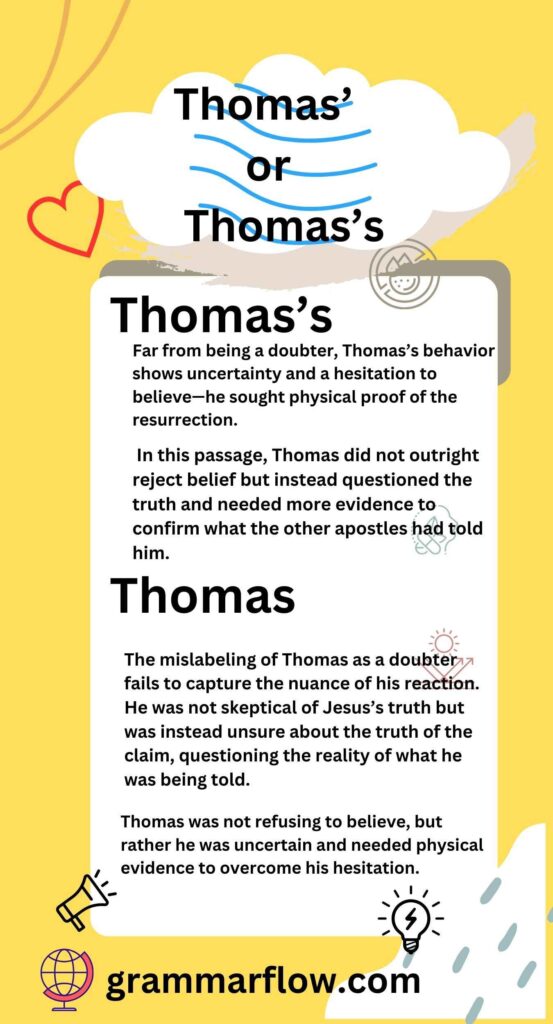
The common label of Doubting Thomas misrepresents the true nature of Thomas’s reaction in the biblical passage. Far from being a doubter, Thomas’s behavior shows uncertainty and a hesitation to believe—he sought physical proof of the resurrection. In this passage, Thomas did not outright reject belief but instead questioned the truth and needed more evidence to confirm what the other apostles had told him. His desire to see the nail marks in Jesus’s hands and touch his side reflects his need for certainty in the face of extraordinary claims. This act was not one of disbelief but rather a request for clarity and reassurance, typical of anyone confronted with something as profound as the resurrection.
The mislabeling of Thomas as a doubter fails to capture the nuance of his reaction. He was not skeptical of Jesus’s truth but was instead unsure about the truth of the claim, questioning the reality of what he was being told. Thomas was not refusing to believe, but rather he was uncertain and needed physical evidence to overcome his hesitation. This is a critical distinction. Skeptical Thomas should be understood more accurately as Thomas who hesitated or Thomas who questioned, as he did not fully reject the resurrection belief, but rather had doubts that he sought to resolve.
You might enjoy reading: Heartfelt Ways to Say ‘Thanks for the Warm Welcome’
Two reasons this matters:

Understanding the apostrophe in Thomas’s name is important for two key reasons. First, it helps clarify the belief system around Thomas’s role in the resurrection narrative. The common label of Doubting Thomas does not accurately reflect the faith he demonstrated after his encounter with the risen Jesus. Instead of being a doubter in the traditional sense, Thomas showed a natural uncertainty about the truth of the resurrection. His need for evidence reflects a belief that was not without questions, but he still maintained a genuine faith once he was given the proof he sought. Mislabeling him as a doubter can distort the theological implications of his belief and the mercy shown to him.
Second, the way we interpret doubt and faith influences how we approach spiritual care and understand belief formation. When we label someone as a doubter, we might overlook the spiritual struggle between belief and doubt that many people face. Thomas exemplifies how doubt can coexist with a genuine search for certainty in belief. In this light, doubt is not the opposite of faith but rather part of the process of developing a firm belief. Understanding this dynamic can help us approach others with grace and mercy when they struggle with doubt in their spiritual beliefs, allowing them to grow through uncertainty rather than feel condemned by it.
You might enjoy reading: Better Ways to Say ‘Enjoy Your Time Off’ in an Email

