
Picture this: you’re talking about an orange in a fruit bowl. You ask, “Is there any orange left?” But if you’re eyeing apples, it’s “Are there any apples?” The difference hinges on subject-verb agreement—singular nouns pair with “is there any,” plural ones with “are there any.” Accidentally mixing them up? You’re not alone. This rule trips up even professional writers because English grammar depends on context.
Why should you care? Using the correct phrase makes your writing clearer and readable. For example, “Is there any milk?” (uncountable) vs. “Are there any cookies?” (plural). Remember: your choice covers what you’re referring to. Learning this construction avoids grammatically messy sentences. Pro tip: check the noun first—both “is” and “are” complete the sentence, but only one fits correctly.
Difference Between Is There Any and Are There Any
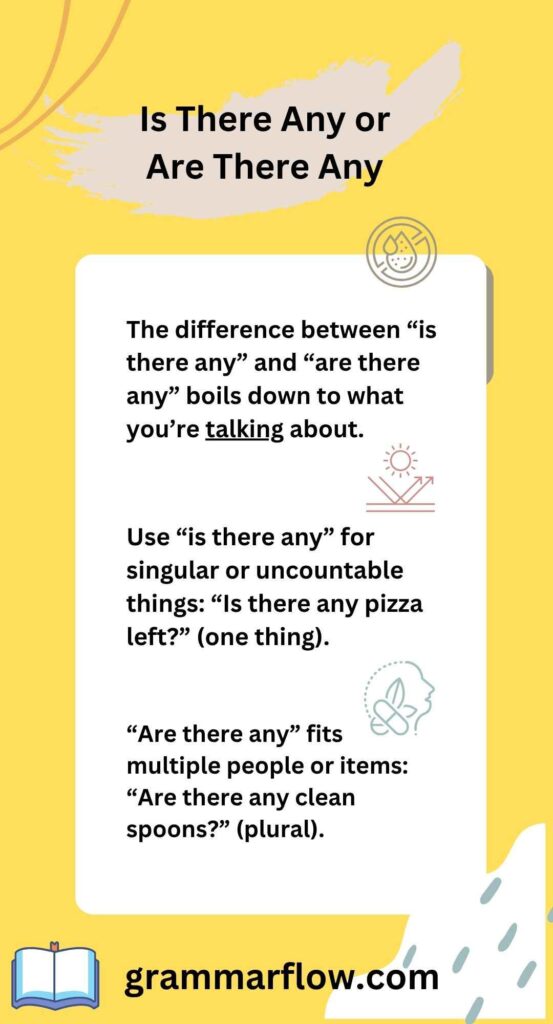
The difference between “is there any” and “are there any” boils down to what you’re talking about. Use “is there any” for singular or uncountable things: “Is there any pizza left?” (one thing). “Are there any” fits multiple people or items: “Are there any clean spoons?” (plural). Picture this: you’re craving an Italian restaurant nearby—ask, “Is there any good spot here?” But if you want three restaurants to choose from, switch to “Are there any locations close by?”
This rule holds true even when asking oddly specific questions. Return to the earlier pizza example: if you say “Are there any slices?” you’re eyeing multiple pieces, not the whole pie. Remember: the noun after “any” decides the question’s fate. Master this, and you’ll dodge grammar landmines—whether talking trash bins or hidden gems.
You might enjoy reading Impressive Ways to Express ‘I Look Forward to Speaking With You’
How to Use Is There Any Correctly

Use “Is there any” to ask if something exists—like checking your fridge: “Is there any butter?” (an uncountable noun). This sentence construction works for love, bread, or abstract ideas, where you can’t quantify numerically. But saying “three breads” is grammatically incorrect unless you specify units like slices or loaves. If you’re talking about a specific place or key difference, like “Is there any chance?”, stick to singular/uncountable terms. Common examples? “Is there any bread left?” (yes, even if it’s a lot or a little bit).
How to Use Are There Any Correctly
Use “Are there any” when asking about plural, countable nouns—like at a bakery: “Are there any croissants left?” (The answer could be three or twenty). This sentence construction works for problems at work (“Are there any issues?”) or people in a room (“Are there any doctors here?”). Say you’re in a specific place, like a pantry—ask, “Are there any loaves of bread?” to specify units, not the uncountable “bread.”
Need help today? Respond to generic quantity with “Are there any tasks?” (Avoid “lots” or “some”—stick to countable terms). Time-crunch tip: If you can number it (three apples, twenty emails), “are there any” fits. Just don’t ask, “Is there any time?”—that’s an uncountable noun blunder!
Examples of “Is There Any” or “Are There Any
Let’s look at some examples of each of these sentence constructions from popular writings.
Examples of Is There Any Used Correctly

- In Deanna Raybourn’s A Midsummer Night, a character whispers, “Is there any meaning to life before inevitable death?” —using the phrase to grapple with uncountable nouns like existential dread. Ian McEwan’s Atonement sharpens it: “Is there any certainty in what you’ve done?” Here, “any” questions moral clarity, not countable items.
Stephen King’s 11/22/63 twists it: “Is there any single person responsible for how everything happens?” The phrase digs into dependent factors, not people you can number. Even M.T. Edvardsson’s A Nearly Normal Family asks, “Is there any way for body and soul to live comfortably?” —planning for peace, not objects.
Cecil Castellucci’s Boy Proof wonders, “Is there any world where I dream freely?” Unimagined realms aren’t quantifiable, just hoped for. Neil Gaiman’s Worlds’ End layers it: “Is there any ride long enough to escape fate?” Situations, not things, dominate these successful English books.
Each example proves “is there any” thrives with abstract, singular, or uncountable nouns—finer phrase work than counting croissants.
Examples of Are There Any Used Correctly
In Geraldine Brooks’ March, a soldier asks, “Are there any rules left for love?” —using the phrase to hunt for plural ideals, not solitary truths. Cassandra Clare’s Clockwork Prince sharpens it: “Are there any leading men in life who don’t change?” Here, “any” seeks people, countable and flawed.
Haruki Murakami’s Kafka on the Shore twists it: “Are there any capitalist cats in this world?” —a quirky example of closely twinned absurdity and curiosity. Emma Mills’ First & Then asks, “Are there any particular majors you’re interested in?” targeting plural choices. Even courage and cowardice, two words yearning to possess us, fit here: “Are there any men alive who dread the latter but are accused of the former?”
You might enjoy reading: Upgrade Your Email: Other Ways to Say ‘Hope You Had a Great Weekend’
How About If There Is Any or If There Are Any?
The general rule still applies: use “if there is any” with singular, uncountable, or countable nouns (“If there is any milk, save it for coffee”). Switch to “if there are any” for plural nouns (“If there are any leftovers, toss them”). Imagine hosting a party—“If there is any cake left, wrap it” (one dessert) vs. “If there are any broken cups, recycle them” (multiple items).
These phrases work like traffic lights: “is” stops at single/abstract things (“If there is any hope, hold onto it”), while “are” green-lights multiples (“If there are any tickets, grab two”). Stuck? Check the noun after “any”—is it singular or plural? Your phrasing depends on that distinction.
Examples of If There Is Any
In Paulo Coelho’s The Witch of Portobello, a character pleads, “If there is any possible consolation in losing someone you love, let it be necessary hope”—using the phrase to grapple with tragedy. Will Durant’s The Pleasures of Philosophy sharpens it: “If there is any intelligence guiding the universe, why does society let robbers and murderers abstain from robbing, then relapse?” Here, “if there is any” questions cosmic justice.
Adam Smith’s Theory of Moral Sentiments asks, “If there is any good in life, it lies in facing fear with none left to invoke”—philosophy that digs into human passion. Elizabeth Kostova’s The Historian layers history with longing: “If there is any past lived reverently, it’s in work that knows how to understand history.”
These examples from English books show “if there is any” isn’t just grammar—it’s a bridge between best hopes and brutal truths.
Examples of If There Are Any
Picture a baseball fan on Chicago’s north side grumbling, “If there are any curses left, the Boston Red Sox stole them all”—a playful jab using plural frustration. In Richard Yates’ Eleven Kinds of Loneliness, a character mutters, “If there are any windows in this house, they’re hiding”—highlighting rudimentary despair with countable things.
Gilles Fauconnier’s The Way We Think dissects language: “If there are any pidgin codes or creole languages left, they reveal the complexity of children learning under limits. Noah Hawley’s Before the Fall sharpens it: “If there are any muscles in your head physically fit for thought, use them now”—mixing body and mind.
These examples show “if there are any” thrives when hunting for plural answers—whether tracking linguae francae or ears attuned to truth.
You might enjoy reading: Top Roasts to Keep Your Brother Laughing
Conclusion on Is There Any or Are There Any
When doubt creeps in—“Is there any coffee?” vs. “Are there any cookies?” —Use this golden rule: “is” pairs with singular/uncountable nouns, and “are” with plural. The word after “any” decides the answer. Forgot? Tools like ProWritingAid catch these subject-verb agreement issues before they embarrass you.
Imagine proofreading a text: “Are there any errors here?” Oops! The grammar errors scream, Are there any errors?” is correct. Train your eye to see the noun first. Writing becomes smoother when “is” and “are” align like puzzle pieces.
Why stress? Next time you’re answering a friend’s “Is there any milk?”, nod wisely. You’ve cracked a rule that trips up pros. Your writing? It just leveled up.

