

The words storey and story may seem similar, but they have different meanings and uses, which can lead to confusion. In American English, story refers to both a narrative or an event (true or imagined) and a floor of a building. For example, “a story in a book” or “a two-story house”. However, in Australian English and some other varieties of English, storey is used to describe the floor of a building, while story refers to a narrative or account of events.
The difference is not just in spelling, but also in context. For instance, when describing a building, you would use storey to refer to each level, like a single-storey house or a building with multiple storeys. On the other hand, if you’re talking about a narrative, such as a book or an author’s account of events, you would use story. This subtle difference is important when writing, especially when using the plural form, where stories is the correct plural for narratives and storeys is the plural for the levels of a building. Understanding these distinctions helps ensure you’re using the correct word in the right context.s
Is it Story or Storey?
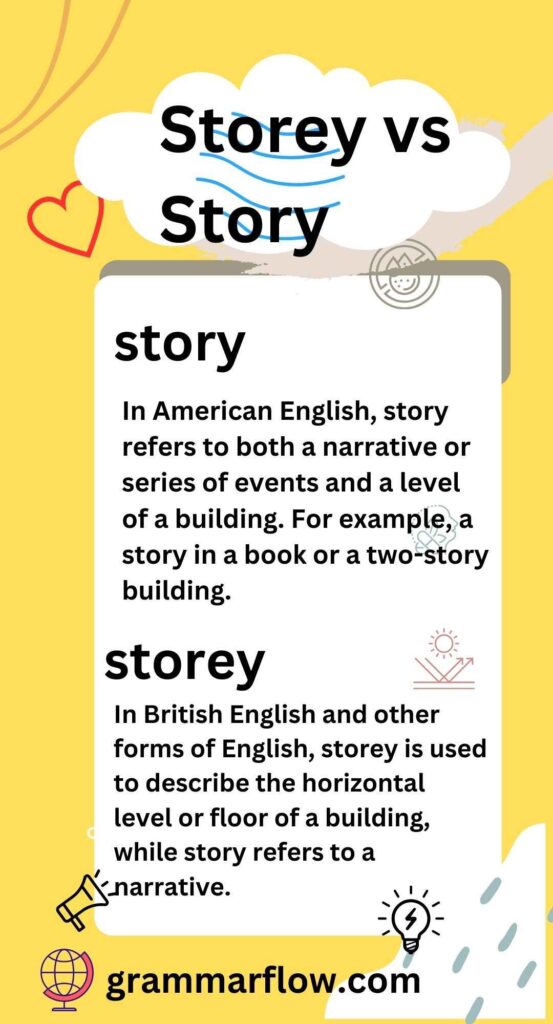
When deciding between story and storey, it’s important to understand their correct usage. In American English, story refers to both a narrative or series of events and a level of a building. For example, a story in a book or a two-story building. However, in British English and other forms of English, storey is used to describe the horizontal level or floor of a building, while story refers to a narrative. Understanding the spelling and definition of each word ensures you’re using the preferred term in the correct context, whether you’re discussing a building or telling a story.
Is it Two-Storey House or Two-Story House?
When referring to a house with two levels, the correct spelling depends on the audience. In American English, the term two-story is commonly used, while in British English, it’s preferred to say two-storey. Both terms refer to the same concept, but they follow different grammatical rules for compound adjectives. For example, in American usage, you might describe a two-story house, while in British English, the same house would be called a two-storey house. This distinction is important when specifying measurements or describing buildings, so it’s essential to use the correct phrase depending on the intended audience.
You might enjoy reading: Is There Any or Are There Any: How to Use Correctly
When to Use Story
The word story is commonly used to describe a narrative or tale about events or people, whether real or imagined. For example, you might say, “Rapunzel is my favorite story,” or “Let me tell you a story about my hometown.” In these cases, story refers to a narrative shared for entertainment or information. However, story can also refer to the horizontal level of a building, such as in a 10-story building or a third-story balcony, depending on the American spelling variant. In this context, it refers to floors in a building, not a tale or narrative. So, when describing levels of a building, like the 40th story of a skyscraper, you’re referring to the height of that particular level. It’s important to recognize the difference between the two uses of story based on context.
Storys or Stories

When making story plural, the correct form is stories, not storys. This follows the general pluralization rule for words that end in y. If the y is preceded by a consonant, as in story, you change the y to ies to make it plural. For example, you would say, “I love reading stories,” not “storys.” This is true in all cases where story refers to a narrative or a tale, whether it’s a building with multiple stories or a story you read in a newspaper.
The rule also applies when story refers to a level of a building. For example, in Boston, there are eight-story buildings or stories that define the height of a retail space or office. Remember, whether it’s about tales or levels, always use stories for the plural form. So, when describing a tall building, or four stories above ground, the correct usage is always stories.
When to Use Storey
In British English, the word storey is used to refer to a level of a building, while story is used in American English. For example, in the UK, a third-storey balcony or a two-storey home would describe the number of levels in a structure. This differs from story, which can also mean a narrative or tale, such as a story about Rapunzel. So, when you’re describing the level of a building in British English, use storey, but if you’re telling a tale or narrative, the correct word is story.
Is There a Plural for Storey?
Yes, the plural of storey is storeys. Just like other nouns that end in y and are preceded by a consonant, you change the y to ies to form the plural. For example, you would say “two-storeys” to describe a house with two levels or storeys. This follows the same rule as other noun forms that require compound adjectives when describing the number of storeys in a building. So, whenever you’re talking about more than one level, remember to use storeys instead of storeys’ or storeys for correct plural usage.
Using Storey in a Sentence
You can use storey to describe the levels or floors of a building, especially in British English. For example, **”The new seven-storey building in Winnipeg will house the Chinese Cultural Community Centre.” Another example could be, “The two-storey house on State Highway 23 in Whatawhata is made of brick and concrete.” Similarly, you might say, “The proposed 50-storey skyscraper in Shanghai will be the tallest building in the area.” These examples show how storey is used to specify the number of levels in a structure. Whether you’re discussing a building in Winnipeg or a skyscraper in Shanghai, using storey helps clarify the height or levels of a structure.
You might enjoy reading: Message or Messege: Examples +Correct Spelling
How to Remember the Difference

To easily remember the difference between story and storey, use this simple trick: “Story” is the word used in American English for both a narrative and a level of a building. On the other hand, storey is used in British English for a level of a building, with the e at the end. Think of England when you see the extra e. The next time you’re confused, just recall that a story tells a sequence of events, while a storey refers to the floor of a building. This way, you’ll be able to easily recall the correct spelling and avoid any confusion.
Summary of Storey vs. Story
The words story and storey have distinct meanings and spellings, depending on whether you’re using American or British English. In American English, story is used for both a narrative or series of events, as well as a level of a building. For example, a story could refer to a book or a building’s floor. In contrast, storey is the preferred term in British English for describing a level of a building, while story refers to a narrative. The additional e in storey marks this difference between the two varieties of English.
While both spellings are common, the distinction lies mainly in the definition and prevalence of usage across the two regions. For example, you would say a two-storey house in the UK, but a two-story house in the US. The plural form of story is stories, but you might encounter storeys when referring to multiple levels of a building in British English. Understanding these differences helps avoid confusion and ensures the correct usage in both writing and grammar.

